Port Knocking
Keeps SSH hidden from unauthorized scans and exposes the service only after the expected knock sequence.
Live Detection and Mitigation for SSH Brute-Force Attacks
Co-authored and experimentally evaluated a layered SSH defense framework for Ubuntu Server combining proactive service concealment, live packet inspection, rate limiting and automated blocking. The controlled testbed demonstrated suspicious SSH activity detection within approximately 2–3 seconds while maintaining a lightweight, practical defense-in-depth design.
The research addresses the limitations of relying on a single control. The proposed design combines proactive attack-surface reduction, live packet analysis and reactive blocking so reconnaissance, repeated connection attempts and persistent brute-force activity are handled at different stages.
The framework coordinates four complementary mechanisms rather than depending on a single detection or prevention tool.
Keeps SSH hidden from unauthorized scans and exposes the service only after the expected knock sequence.
Inspects live TCP connection attempts and flags suspicious SSH patterns before log-only controls react.
Rate-limits repeated connection attempts and drops traffic from persistent sources.
Monitors authentication failures and applies additional bans against repeated login attempts.
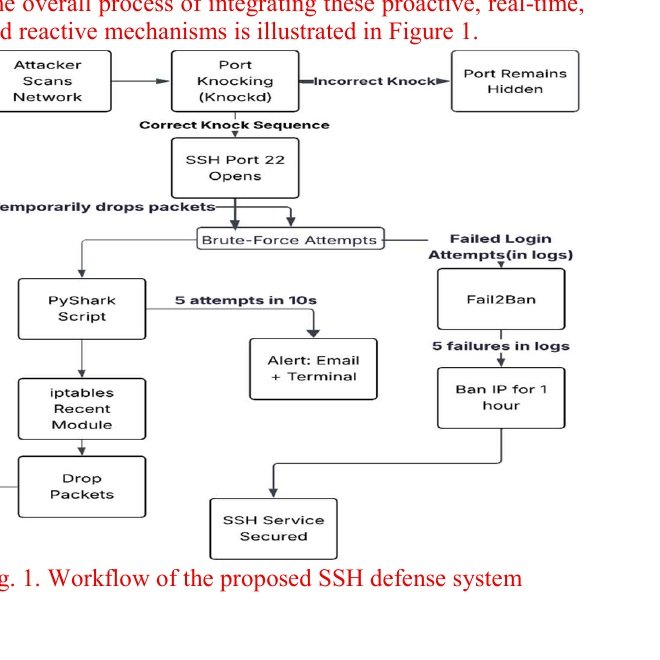
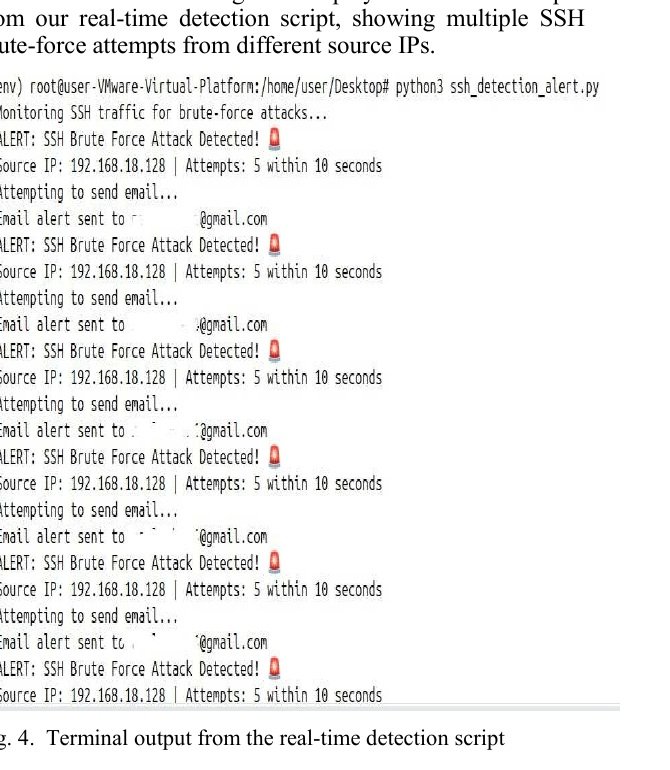
The custom detector uses Python and PyShark to inspect new SSH connection attempts. In the published test configuration, five attempts from the same source within ten seconds trigger terminal and email alerts, providing an early warning before the follow-up blocking layers are reached.
The isolated virtual testbed used Ubuntu Server 24.04.2 LTS as the target and Kali Linux 2023.4 as the attacking host. Nmap was used for port scanning and Hydra for SSH brute-force simulation, allowing the unprotected baseline and layered defense to be compared directly.
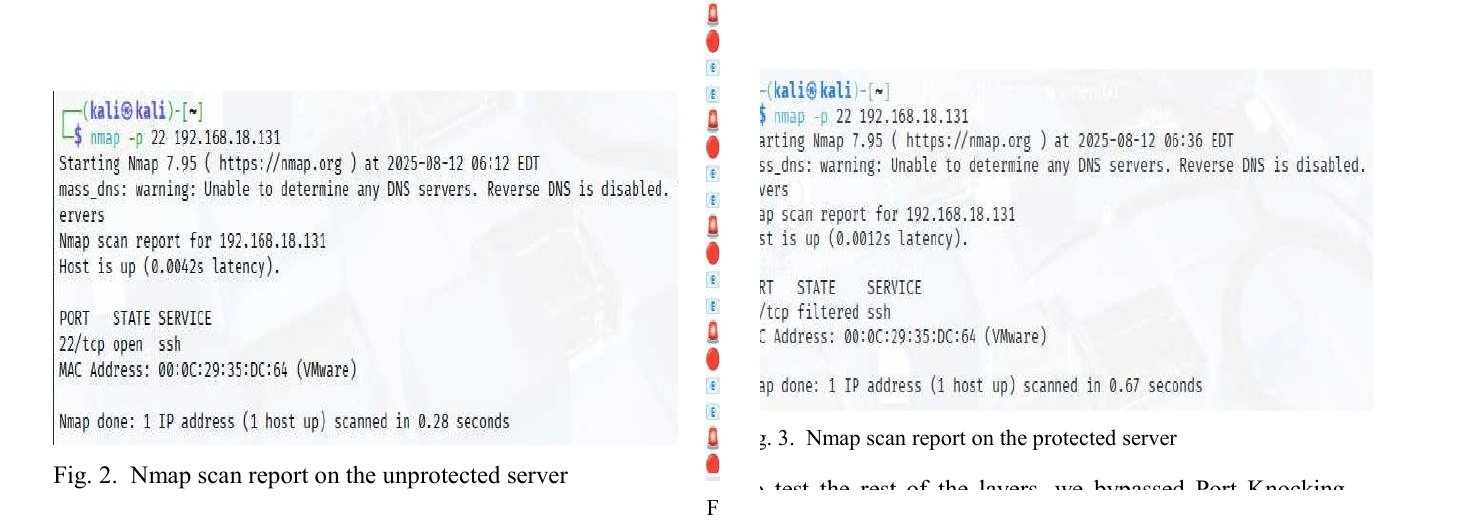
In the hardened test, Port Knocking concealed SSH from the initial scan. After the concealment layer was manually bypassed for testing, the PyShark detector identified the suspicious pattern within approximately 2–3 seconds and generated terminal and email alerts. IPTables then throttled repeated attempts, while Fail2Ban provided additional application-level blocking.
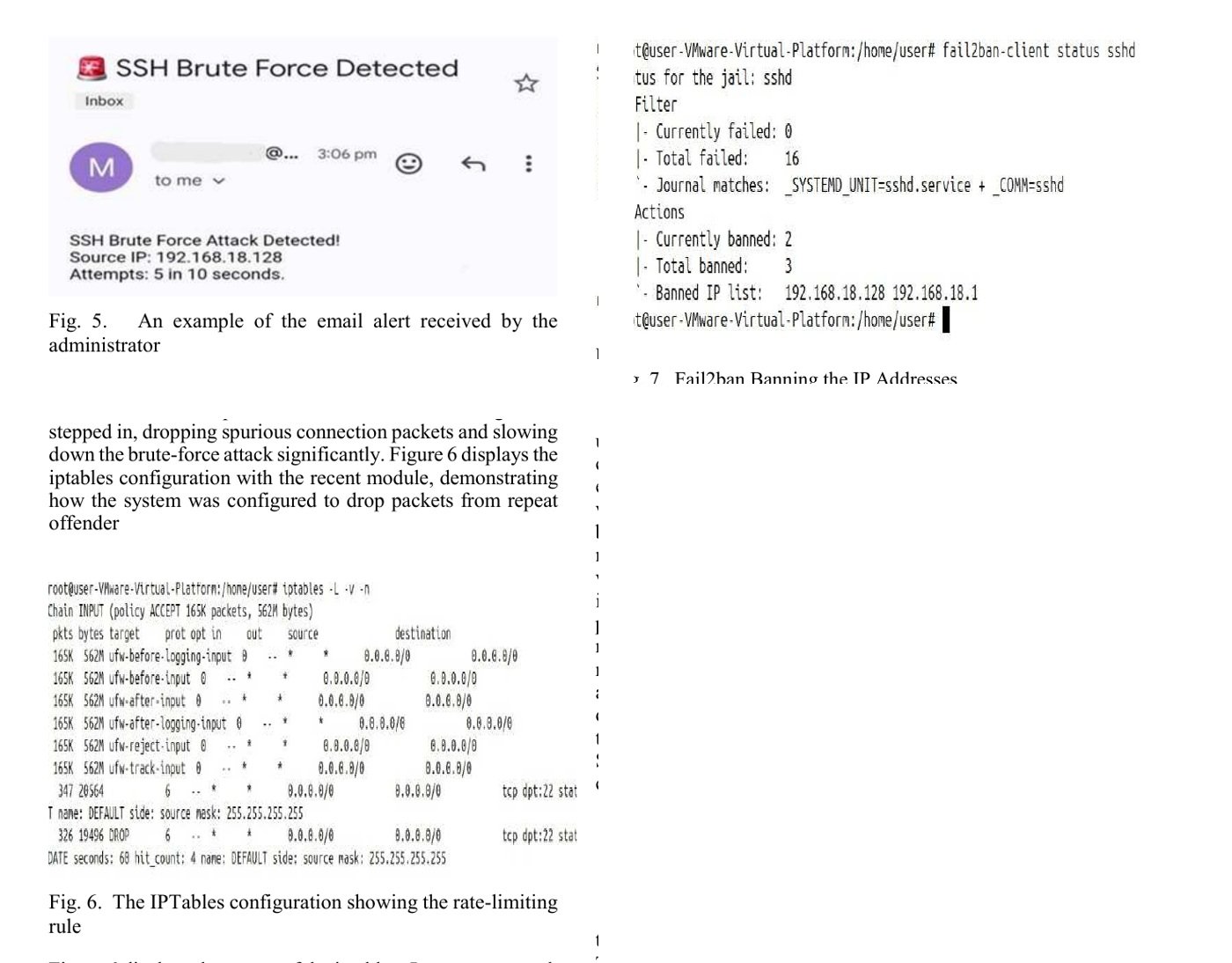
The evaluation showed that established open-source controls can be coordinated into a practical SSH defense architecture combining attack-surface reduction, early packet-level detection and automated mitigation without relying on a computationally heavy machine-learning IDS.
Co-authored with Nael Zahreldine, Ahmad Hani El Fawal, Dani Merhi Bleik and Ali Mansour.